
If you own a home with a septic system in North Georgia — Cumming, Dahlonega, Gainesville, or anywhere in the North Georgia service area we cover — there's one question we get more than any other: how often should I be pumping my septic tank? The answer most websites give you is "every 3 to 5 years." That's not wrong, exactly. But it's also not precise enough to help you actually plan.
This guide breaks down the real factors that determine pumping frequency, gives you a way to estimate your own schedule, and explains what happens when you wait too long. We'll also cover a few things specific to Forsyth, Hall, Cherokee, and the other North Georgia counties we work in every week.
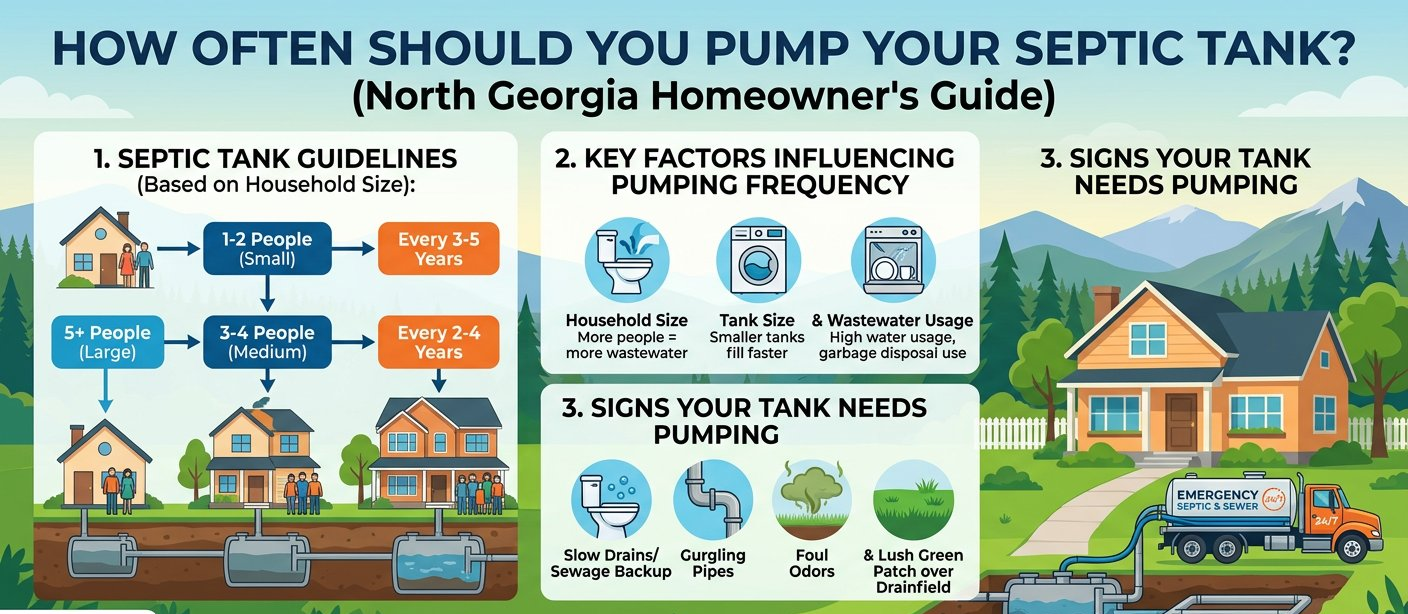
The simple answer (and why it's not enough)
The EPA and most state environmental departments recommend pumping a residential septic tank every 3 to 5 years. That range is fine as a starting point, but it's so wide it borders on useless. The difference between pumping every 3 years and every 5 years can be the difference between a — service visit and a — drain field replacement.
The real answer depends on five things: tank size, household size, water use habits, garbage disposal use, and whether you have any system add-ons like effluent filters or aerobic treatment units.
Tank size: bigger tank, longer interval
Septic tanks for single-family homes in North Georgia typically range from 750 gallons (older homes, pre-1990) up to 1,500 gallons (newer construction, larger homes). The bigger the tank, the more buffer you have between pumpings.
- 750-gallon tank: Common in homes built before 1990. Pump every 2-3 years for a family of 4.
- 1,000-gallon tank: Standard for most homes built 1990-2010. Pump every 3-4 years for a family of 4.
- 1,250 to 1,500-gallon tank: Common in newer larger homes. Pump every 4-5 years for a family of 4.
Not sure what size tank you have? Forsyth County (and most North Georgia counties) keep septic permit records that include tank size for homes built after the mid-1990s. We can also pull records for you when we come out for service — or measure during your first pumping if records are missing.
Household size: every person is a load
The other big variable is how many people live in the house. The EPA estimates each person produces about 70 gallons of wastewater per day. A family of 5 puts roughly 25% more load on a septic system than a family of 4. Two people in a 4-bedroom house with a 1,500-gallon tank may go 6+ years between pumpings without trouble; the same house with 5 occupants needs service every 3 years.
A useful rule of thumb: for a 1,000-gallon tank, divide 5 years by the number of occupants and round down. Four people = ~3 years. Six people = ~2 years.
Habits that shorten the interval
Some homes go through tanks faster because of how they're used, not just who lives there. Things that shorten the time between pumpings:
- Garbage disposal use. Frequent disposal use roughly doubles the rate at which solids accumulate in your tank. If you use yours daily, plan to pump twice as often as the table above suggests.
- High-volume laundry. Multiple loads per day push water through the system faster than the tank can settle solids — increasing the chance of solids escaping to the drain field.
- Long-term vacation rentals or Airbnb operations. Variable occupancy means inconsistent load. We see disproportionate sludge buildup in short-term rental properties.
- Chemical drain cleaners. The harsh chemistry kills the biological action that breaks down waste in the tank, allowing solids to accumulate faster than normal.
- Flushing things you shouldn't. Wipes (even "flushable" ones), feminine products, paper towels, cigarette butts, and food scraps don't break down properly and accumulate as inert sludge.
What happens if you wait too long
This is the part most homeowners underestimate. When you go years past the right pumping interval, you don't just get a fuller tank — you start pushing solids out the outlet baffle into the drain field. And drain field damage is where septic system costs explode.
A drain field clogged with solids cannot be "pumped clean." The soil itself becomes saturated with biomat, the perforated pipes get fouled, and percolation rates drop. Once that happens, you're looking at one of three outcomes:
- Drain field rejuvenation (— if the damage is mild and caught early)
- Drain field replacement (— for a standard residential system)
- Conversion to alternative system (— if soil percolation can no longer be restored)
Compare that to a routine pump-out at ~— every 3-4 years. The math on staying ahead of the curve is obvious.
Specific to North Georgia: clay soil makes this worse
Forsyth, Cherokee, and Hall counties all have significant red-clay subsoil. Clay drains slowly even when healthy — meaning if you push solids into a clay drain field, recovery is harder and slower than in sandy or loamy soils. North Georgia homeowners can't afford to be casual about pumping schedules.
What about additives and "never pump" treatments?
Short answer: no.
Septic tank additives sold at home improvement stores (Rid-X, Bio-Tab, etc.) won't damage your system, but they also won't extend pumping intervals in any meaningful way. The bacteria already in your tank are doing the bulk of the work — and additives have not been shown in controlled studies to reduce sludge accumulation enough to skip pumpings.
Treatments that claim you'll "never need to pump again" are even less defensible. There is no chemistry that turns inorganic solids — small bits of plastic, grit, food scraps — back into liquid. Sludge always accumulates. Skipping pumpings just delays an inevitable and much more expensive repair.
Signs you've already waited too long
Don't wait for sewage in the yard — most septic systems give warning signs weeks or months before failure. Call us if you notice any of these:
- Slow drains throughout the house (not just one fixture)
- Gurgling sounds from drains or toilets
- Sewage smell indoors or outside near the tank
- Lush, overly green grass over the drain field
- Standing water or soggy ground near the system, especially in dry weather
- Toilets that back up when running the washing machine or shower
What to expect from a pumping appointment
A proper pump-out is more than just emptying the tank. It's also an inspection. Here's what we do on every service call:
- Locate and uncover the tank access (free if you don't know where it is)
- Measure sludge depth and scum thickness before pumping
- Pump out all compartments completely
- Inspect inlet and outlet baffles for damage or clogging
- Clean effluent filter (if equipped)
- Inspect interior tank walls for cracks, leaks, or root intrusion
- Provide a written service report with photos, measurements, and a recommended next-pump date
For more on what's included, see our septic tank pumping service page.
The North Georgia-specific cheat sheet
If you don't want to think about it, use these intervals as your baseline:
- 2 people, 1,000+ gal tank: Every 5-6 years
- 3-4 people, 1,000 gal tank: Every 3-4 years
- 3-4 people, 1,500 gal tank: Every 4-5 years
- 5+ people, 1,000 gal tank: Every 2-3 years
- 5+ people, 1,500 gal tank: Every 3 years
- Vacation home, occasional use: Inspect every 3 years, pump as indicated
- Daily garbage disposal use: Cut all of the above intervals in half
If it's been more than 5 years since your last pumping — regardless of household size or tank specs — you're overdue. Call us at (678) 262-6488 or request a free estimate, and we'll get you on a schedule that actually fits your home.
Need help with your septic or sewer system?
We service the Cumming, GA area and a North Georgia service area — Forsyth, Hall, Dawson, Cherokee, Fulton, Gwinnett, Fannin, Gilmer, and more. Call (678) 262-6488 or request a free estimate online.