
About 35% of Forsyth County homes are still served by septic systems, and in surrounding counties (Dawson, Lumpkin, parts of Cherokee), that number climbs north of 70%. If you're buying in our area, there's a strong chance the home you're under contract on has a septic system. And septic systems are where the biggest post close surprises happen.
This guide walks you through the seven things to verify before you close on a home with a septic system. Skip any of them and you risk inheriting a problem that will cost you thousands, or, worse, derail your closing at the last minute.
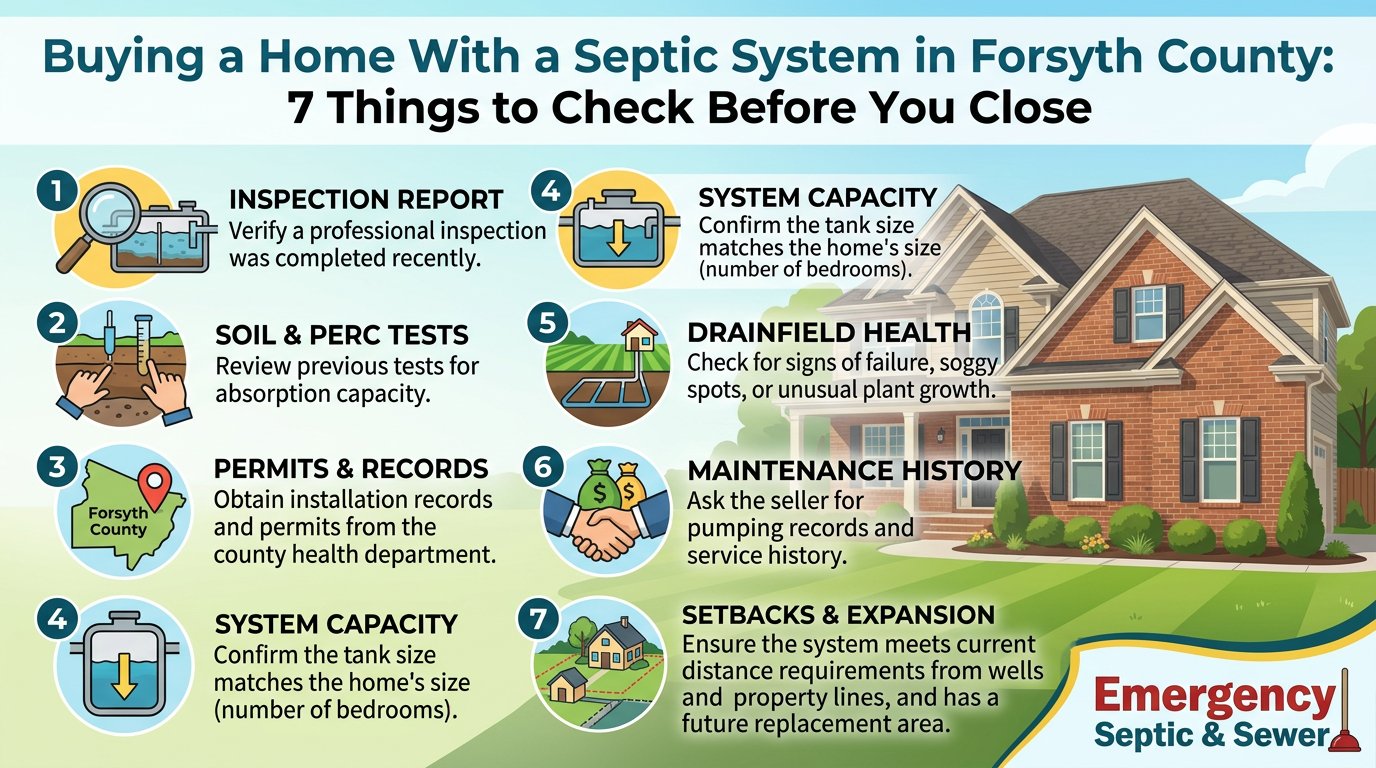
1. Confirm the system actually exists where the seller says it does
Sounds obvious. It's not. We turn up to inspect systems all the time where the disclosure points at the wrong spot, the records are gone, or the last owner simply forgot where the tank lids are buried (sometimes literally under a deck or driveway).
Forsyth County keeps septic permit records on file at the Environmental Health Department. These include the as installed location, tank size, drain field design, and any repair history after the mid-1990s. Older homes may have incomplete or missing records. Either way, the inspection report should confirm location with on site measurements, not just regurgitate what the disclosure says.
2. Verify tank size matches the home
Tanks installed before 1990 are sometimes undersized for the homes they serve. A 4 bedroom house with a 750 gallon tank is essentially a system perpetually on the verge of failure. It can be made to work with frequent pumping, but it's a bad starting point.
Georgia code now requires minimum tank sizes based on number of bedrooms.
- 1 To 3 bedrooms. Minimum 1,000 gallons
- 4 bedrooms. Minimum 1,200 gallons
- 5 to 6 bedrooms. Minimum 1,500 gallons
If you're buying a home that's been added on to over the years, say, an original 3 bedroom ranch with a finished basement bedroom and an addition. The original tank may be undersized for current use. Check this against the permit records as part of the inspection.
3. Get the drain field load tested
Anybody can pump the tank and call it an inspection. A real evaluation includes a drain field load test, introducing a measured volume of water into the system over a specified time and observing how the drain field responds. A healthy drain field can accept 100+ gallons over 20 minutes without surface ponding. A struggling drain field will show pooling, slow absorption, or even backflow into the tank.
This is the single most important diagnostic for predicting future failure. Tanks can be replaced for. Drain fields cost. If the drain field is on its way out, you need to know before you close.
Local context. Clay soil and slope
Forsyth County's clay heavy soil means drain fields recover slowly from saturation events. A drain field that's marginal during a wet inspection may seem to recover in dry weather, but the underlying biomat damage is permanent. Trust the inspection result, not the seasonal appearance.
4. Camera scope the sewer line between the house and the tank
The line connecting the house to the septic tank is one of the most overlooked failure points in residential systems. A camera scope through the cleanout reveals.
- Root intrusion at pipe joints (extremely common in trees everywhere Forsyth County)
- Belly or sag in the line where solids settle and block flow
- Pipe collapse, especially on properties with cast iron or clay tile sewer laterals
- Improperly bedded pipe that's settled and offset
A sewer line repair from house to tank typically runs, depending on length and depth. Discovering this before closing means it becomes a negotiation point. Discovering it three months after closing means it's entirely your problem. See our sewer line cleaning service for more on what's typically found.
5. Check setbacks if the property is near water
Georgia requires minimum setback distances between septic systems and various features. The big ones.
- 100 Feet from any well
- 50 feet from a lake, stream, or pond (often 100+ feet for protected waters)
- 10 feet from any building or foundation
- 5 feet from property lines
- 10 feet from driveways or pavement
Homes near Lake Lanier, the Etowah River, Big Creek or the small lakes around Cumming can face tighter rules. Those come from the state Environmental Protection Division. An inspection before you buy should check the system still meets current setback rules. If it is grandfathered in, the report should say so. Otherwise it turns into a problem the day you try to repair or replace it.
6. Pull and review the maintenance history
How well has this system been cared for? The seller's disclosure should include pumping records. If it doesn't, or if the records show no pumping in the last 7+ years, that's a yellow flag. It doesn't necessarily mean the system is bad, but it does mean you're inheriting unknown maintenance status.
For ATU (aerobic treatment) and other alternative systems, the maintenance record is even more critical. These systems require annual service contracts in many Georgia counties, and lapses in service can violate the original permit conditions. Ask for the maintenance contract record going back at least 3 years.
7. Get an actual inspection report, not just a pump out
The biggest mistake we see real estate buyers make is treating "the septic was pumped" as equivalent to "the septic was inspected." These are not the same thing.
A pump out is an emptying. An inspection is an evaluation. The inspection should give you a written report with photos and a signature. It should cover at least 20 checkpoints, and a 27 point checklist like the one we use for real estate inspection reports.
The report should specifically include.
- Tank location, size, material, and age
- Inlet and outlet baffle condition
- Sludge depth and scum layer measurements
- Drain field surface inspection and load test results
- Sewer line camera scope (house to tank)
- Photo documentation of significant findings
- Severity ratings on any issues identified
- Repair recommendations with estimated costs
- Inspector signature, license number, and date
Underwriters, lenders, and most real estate attorneys will want all of this. Insist on it.
What about the seller's disclosure?
Georgia is a buyer beware state with limited mandatory disclosure requirements for septic systems. The seller is required to disclose known material defects, but the operative word is known. If the seller hasn't had the system properly evaluated, they may genuinely not know about issues that an inspector will find immediately. This is why a third party inspection is non negotiable, regardless of how clean the disclosure looks.
Timing your inspection
For most Forsyth County transactions, we recommend ordering the septic inspection in the first half of your due diligence period. Reports land 24 to 48 hours after the visit. If the report calls for repairs, you want time to price them before due diligence expires. Last minute inspections that surface major issues often result in rushed negotiations or extension requests.
Closing in 30 days?
Whoever you call, call somebody who does this for a living. The directory lists the septic and sewer companies in each market it covers, ordered by review count, with nobody paying for a position.
The bottom line
Septic systems aren't scary. They're just another major home component that requires due diligence before purchase. A thorough inspection costs, and typically takes 60 to 90 minutes on site. That investment can save you, in post close repairs, or give you legitimate leverage to negotiate repair credits, price reductions, or seller paid repairs.
Whoever you call, call somebody who does this for a living. The directory lists the septic and sewer companies in each market it covers, ordered by review count, with nobody paying for a position.
Need someone who does this for a living?
The directory lists every septic and sewer company in each market it covers, checked against its own public record and ordered by review count. Find one near you.